European Central Bank (ECB) President Christine Lagarde gave several speeches over the past week in which she repeated her familiar message about the risks of higher inflation and the need to hold interest rates higher for longer.
However, various ECB officials have softened their tone and started to lean towards the dovish side. ECB Governing Council member Yannis Stournaras warned against early bets on a rate cut, but added that he would expect such a move in mid-2024.
ECB executive board member and Bank of Italy governor Fabio Panetta also said that the current level of interest rates was consistent with bringing inflation down to target and warned of the "unnecessary damage" that the ECB could cause with sustained high interest rates.
In addition, the euro slumped on Thursday (30.11.2023) on reports suggesting that the central bank could suspend reinvestment of the Pandemic Emergency Purchase Program (PEPP) in the final days of 2023 due to low liquidity.
Dove surprise from Fed officials
In the United States, investors were shocked by dovish comments from Federal Reserve (Fed) officials. Christopher Waller said that the recent slowdown in economic activity is encouraging because it may indicate that monetary policy is tight enough to curb inflation. Waller added that if inflation continues to fall for a few more months, the central bank could cut the key rate.
Macroeconomic data point to no more rate hikes
Inflation has taken centre stage in recent days, with the figures fuelling optimism as price pressures eased on both sides of the Atlantic. German Harmonised Index of Consumer Prices (HICP) inflation climbed to 2.3% year-on-year in November, down from 3% in the previous month. The euro area HICP rose by 2.4% in the same period from 2.9% in October.
Finally, the United States (US) released the October Personal Consumption Expenditures (PCE) price index, the Fed's favourite inflation gauge. According to the Bureau of Economic Analysis (BEA), the headline annual PCE price index increased by 3.5% year-on-year, as expected, but below the 3.7% recorded in September.
Meanwhile, the US revised upwards its gross domestic product (GDP) for Q3, which recorded an annualized growth rate of 5.2%.
Finally, the US released the ISM Manufacturing PMI , which came in at 46.7 in November, matching October's reading and missing expectations of 47.6.
The focus shifts to the labour market
Overall, the data suggest that growth remains stable while inflation continues to decline. The labour market needs to ease further for central banks to confirm a change in monetary policy.
The focus will be on U.S. employment data as the country releases the Nonfarm Job Openings (NFP) report on Friday (08.12.2023), preceded by the usual ADP survey, JOLTS Job Openings, the quarterly Unit Labor Costs and Nonfarm Productivity reports.
Technical outlook
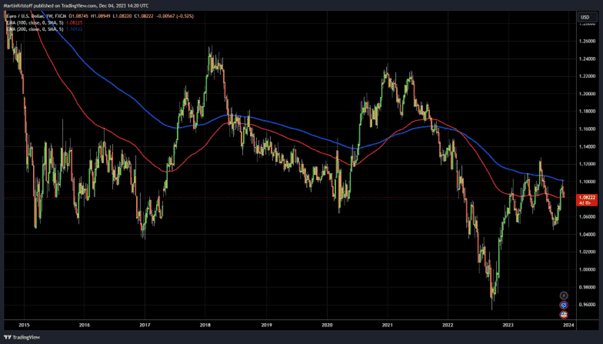
EUR/USD is facing resistance in the 1.0890-1.0900 area, where the 100-day simple moving average (SMA) on the 4-hour chart and the Fibonacci 23.6% retracement of the latest uptrend coincide. If the pair rises above this level and starts using it as support, technical buyers could show interest and open room for an extended recovery towards 1.0930 and 1.1000.
On the other hand, 1.0800 and 1.0750 (200-day SMA) could act as support if EUR/USD fails to reach 1.890-10900.