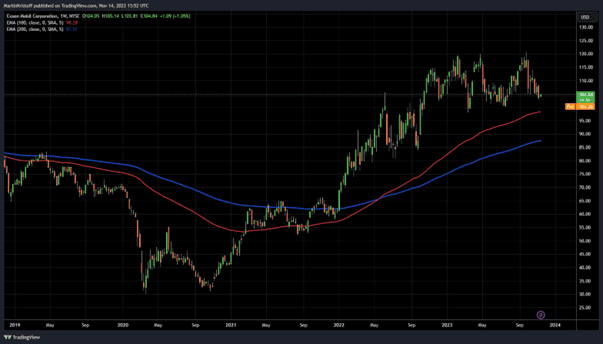
ExxonMobil believes the world will need oil and gas for a very long time. This drives its current investment strategy of investing billions of dollars a year to develop new supplies of oil and gas.
Slow transition to renewables
However, the world is slowly transitioning to low-carbon energy, including electric vehicles (EVs) powered by renewable sources. This is leading energy companies to invest more money in transitioning their businesses to a low-carbon world. It recently unveiled bold plans to become a leading lithium producer by 2030.
First phase of the project
ExxonMobil has already begun work on the first phase of a lithium production project in Arkansas, which has "vast" lithium resources. This project is expected to start production by 2027. It is likely to be the first of many for the energy giant, which is considering other lithium production opportunities around the world. The company's goal is to produce enough lithium to power more than 1 million electric vehicles a year by 2030. It will market its lithium product under the Mobil Lithium brand.
The energy company secured rights to more than 120,000 acres in southern Arkansas earlier this year. This land lies above the Smackover Formation, which contains the most abundant lithium resources in North America.
Exxon will use traditional oil and gas extraction methods to extract lithium-rich salt water from the formation, which is about 10,000 feet below the Earth's surface. Exxon will then use direct lithium extraction (DLE) technology to separate the lithium from the salt water. The company will re-inject the salt water into the formation while converting the lithium into battery-grade material. This production process requires less land and produces fewer emissions than hard rock mining.
The growth in demand for oil and gas is coming to an end
While Exxon believes oil and gas will remain vital fuels for decades, demand growth is coming to an end. According to the International Energy Agency (IEA), demand for oil and gas will peak by 2030 and plateau for the next two decades. The rise of electric vehicles is a big driver of this view. By 2030, the IEA expects nearly 10 times the number of EVs on the road than today.
This outlook suggests that Exxon will need to find a new growth engine by the end of this decade. Exxon noted that demand for minerals will quadruple by 2030 due to the growth of electric vehicles. This drives Exxon's view that there should be plenty of opportunities to invest in new lithium projects in the coming years. The company noted that it is evaluating growth opportunities globally. It is also discussing lithium supply agreements with potential customers, including EV and battery makers.
USD 4.9 billion acquisition
The oil giant is the new leader in providing carbon capture solutions. It recently reinforced these ambitions with the acquisition of Denbury Resources in a $4.9 billion deal. Exxon now has the largest owned and operated carbon dioxide pipeline network in the country and access to several strategically located sites. Exxon believes it now has the ability to reduce carbon dioxide emissions by more than 100 million tons per year. That's 20 times larger than its current business, which is already the equivalent of replacing 2 million gas-powered cars with electric vehicles.
The energy giant is also investing in other low-carbon technologies such as hydrogen, ammonia, biofuels and direct air capture projects. These low-carbon investments allow Exxon to continue to grow its profits beyond 2030, when demand for oil and gas peaks.
Exxon must switch to another energy source
Oil and gas projects have fueled Exxon's growth over the decades. However, as fossil fuel demand nears a peak, Exxon must switch to another energy source to continue its growth. It sees lithium as a potentially strong growth engine given the exponential growth in demand for this key battery component for electric vehicles. This is driving Exxon to invest in becoming a leader in lithium by the end of this decade. These investments in lithium and other low-carbon technologies make Exxon look like a much more compelling long-term investment opportunity.