
Will this conflict between a major shareholder and management, past and present, affect the share price? Or is it just a public misunderstanding between parties that are basically pursuing the same goals?
The activist investment fund Starboard Value has recently pressured Pfizer to increase shareholder value. Although their support initially appeared to have a positive impact, Pfizer's former CEO and CFO surprisingly changed their stance on October 9 and publicly endorsed current CEO Albert Bourla. In this situation, Starboard, which has invested $1 billion in the ailing pharmaceutical giant, may be keen to take a tougher stance to bring about the desired changes.
No major damage occurred
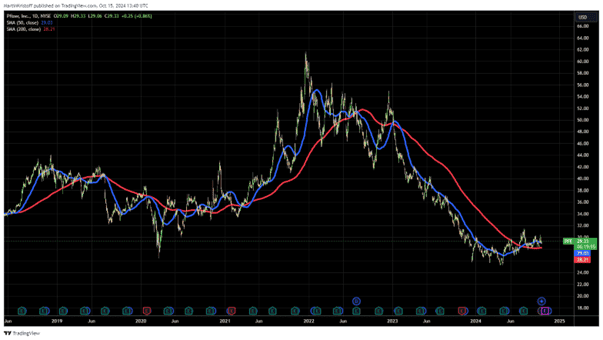
It is necessary to look at the whole situation in a broader context. Although Pfizer's stock is down about 2.5% following the announcement of the former leaders' support for the current leadership, this decline is consistent with the increase in share value that came after Starboard Value announced its stake. The direct impact on the stock is therefore minimal.
Starboard hasn't officially made any proposals for changes to Pfizer yet, but has hinted at a few areas. He says Pfizer has been spending too much on acquisitions recently, which may be a hint at its $43 billion purchase of Seagen, a cancer drug development company, in 2023. It is also likely that Starboard is unhappy with the poorer financial performance of new drugs, such as the respiratory syncytial virus (RSV) vaccine, or with R&D problems, such as the poor clinical results of Pfizer's obesity program.
From this perspective, it is clear that the activist investor campaign is becoming less of an asset to Pfizer's stock, and may even be a slight drag.
Just a few days ago, Starboard's ownership of the stake was seen as an opportunity for Pfizer to get a fresh perspective on addressing the problems of low shareholder returns, presumably through process streamlining or a slightly different drug development strategy. Now, however, that situation has turned into a potential conflict within the company's governance.
In addition, when the former CEO and CFO suddenly changed their support for the investor campaign, it is likely that the board will step in and conduct an investigation to determine to what extent and why the former leaders changed their position. Starboard Value suggests that the board may have pressured former executives to publicly support the current CEO, which may mean further conflicts in the future.
Nevertheless, as Starboard is unlikely to have a sufficient stake to successfully replace management, the actual impact on Pfizer's operations is likely to be minimal.
Public conflicts are not a positive signal
Clear signs of conflict between the shareholder group and Pfizer's management do not bode well for the company and can lead to negative narratives.
It is not appropriate for a company to have to seek the support of former executives to shore up management's position at a time of underperformance. Especially if activist shareholders are trying to bring about improvements.
It is now likely to be harder to convince a wider range of shareholders that there is a coherent strategy that could lead to better growth in shareholder value. In essence, this reversal represents a new risk for shareholders. The more the conflict escalates, the greater the risk that it will actually hurt Pfizer's stock. Right now, this risk appears low, but it may soon change.
With every problem comes an opportunity
Pfizer currently offers three successful oncology drugs,
- Breast Cancer Treatment Inhibitors,research,lifescience,medical
- Xtandi for the treatment of prostate cancer
- Inlyta for the treatment of kidney cancer.
In addition to these, the company has 12 other cancer drugs that generate at least $100 million in sales annually.
Oncology is also one of Pfizer's main areas of research focus. The pharmaceutical company has approximately 40 oncology programs in clinical trials. Several of these focus on expanding the indications of already approved drugs, but Pfizer also has promising new drugs, including an experimental breast cancer drug called atirmociclib.
Pfizer is also leveraging its considerable financial resources to make key acquisitions that bolster its prospects. In 2021, it acquired Trillium Therapeutics, a company dedicated to the development of blood cancer therapeutics, and in 2023 it acquired Seagen, a leader in the development of antibody-cytostatic drug conjugates targeting cancer.
However, Pfizer's success does not depend solely on its oncology products and research. The company is also a leader in the vaccine market, with its new respiratory syncytial virus (RSV) vaccine called Abrysvo having the potential to generate significant sales.
In 2020, cancer treatment in the US will cost approximately $200 billion. By 2030, the total is projected to rise to more than $245 billion.
But with every problem comes an opportunity, in this case a huge opportunity to invest in work to help companies large and small develop new ways to diagnose and treat cancer.
Source.
The data and information contained herein constitutes a marketing communication of HABERL Wealth Management, o.c.p., a.s. This marketing communication is for informational purposes only and the information contained herein does not constitute investment advice or a personal recommendation.